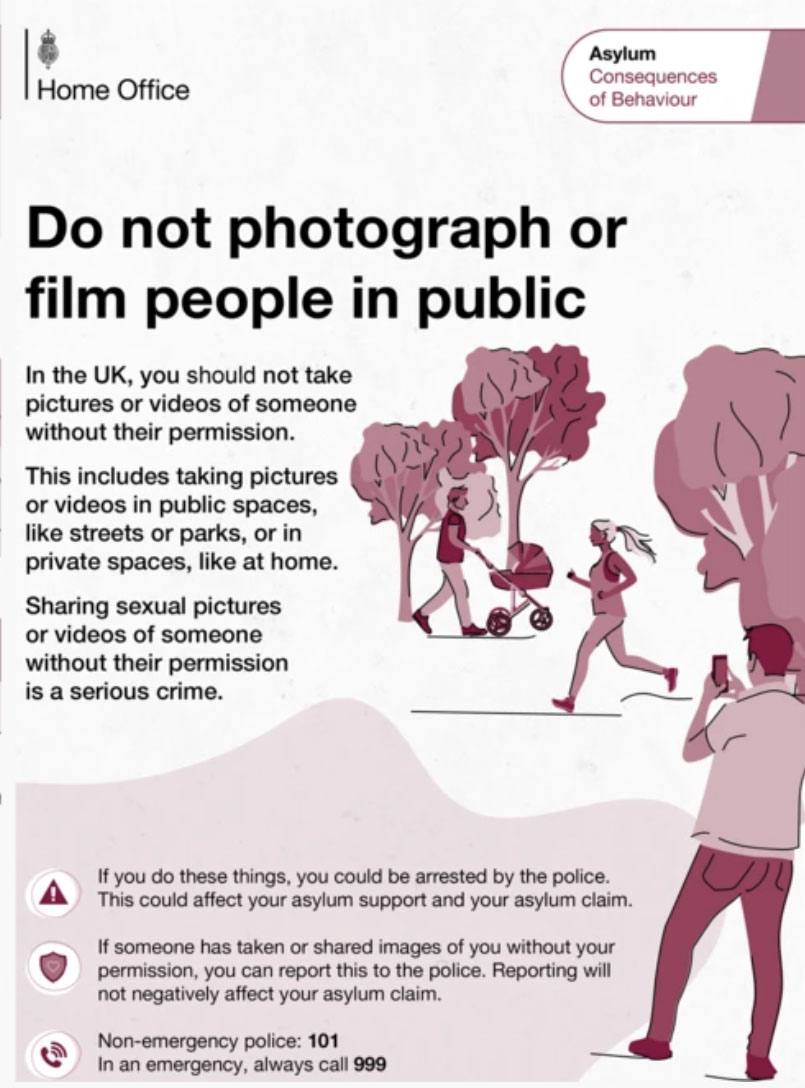
The Home Office has misinformed asylum seekers and the public by claiming they need permission to take photographs or video in a public place and they should correct it immediately.
In a nine-page online booklet the Home Office states: “In the UK, you should not take pictures or videos of someone without their permission.”
It then goes on to say this includes photographs and videos taken in public places such as streets and parks.
This is misleading and wrong. There is no general UK law requiring anyone to obtain a stranger’s permission before photographing them in a public place, a basic right that even the BBC article on the Home Office online booklet missed despite publishing the page in question.
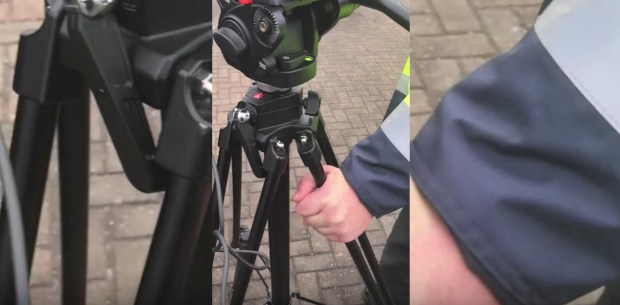
The Home Office own police guidance states: “Members of the public and media do not need a permit to film or photograph in public places” and: “It is not an offence for a member of the public or journalist to take photographs/film of a public building.” [1]
That same guidance says police have no power to stop people photographing or filming incidents or police personnel and explains counter-terrorism powers may be relevant where there is a “reasonable suspicion of hostile terrorist reconnaissance”. [1]
There are laws covering particular forms of photographic conduct.
- Harassment and stalking can constitute criminal offences in appropriate circumstances; [2]
- Voyeurism involving recording a person doing a private act for sexual gratification can be an offence; [3]
- Other legislation regulates specific forms of intimate or sexual imagery.
Photography is an ordinary and legitimate part of public life. Street photographers, documentary photographers, journalists, artists, tourists and members of the public routinely photograph public spaces and the people within them.
People should know their rights and should also understand the boundaries imposed by specific laws.
Informing people that they “should not” photograph anyone without permission, including in public places, risks creating the false impression that ordinary photography is itself unlawful.
UK law is quite clear: “There is no general right to privacy in a public place.”
The Home Office needs to correct this guidance now.
The PHNAT Photography Bust Card to advise you of your rights can be viewed and downloaded here.
Check the law and Home Office Guidance for yourself.